
UK Budget 2026: Healey’s obsession with the government as a household will make the UK’s real households less resilient. And it might have cost the Labour Party a second term in government
Healey’s October 2026 budget speech was a masterclass in saying everything and yet saying nothing. All the buzzwords were present. Growth (13 times), in every postcode (2 times), breathing space (13 times) and ‘fiscal’ (9 times) in various guises, including ‘rules’, ‘constraints’, ‘control’, ‘sustainability ’, and ‘discipline’.
And yet, for all the vibes, the budget said nothing about what it might feel like to live in the UK in the run-up to the next general election. For that, one needs to turn to the Office for Budget Responsibility’s (OBR) economic outlook. If Labour hopes for a second term, the OBR’s report is grim reading.
The government is not a household
Our economy has two types of budgets: those set by households and businesses, and those set by the government. They are fundamentally different, and yet the media, their commentators, and most politicians routinely miss this crucial distinction, with disastrous results for the UK’s resilience and ordinary working people’s living standards.
When a household or a business sets a budget, it is constrained by its earnings and its ability to borrow. It must weigh spending, saving, or investing based on that single financial constraint. By contrast, a government that issues its own currency and is monetarily sovereign, as in the UK, faces no such financial constraint. Consequently, a government budget serves a different purpose.
Rather than seek to balance spending with income, a government budget should address one simple question:
How should it use its money-creation powers to invest in the capacity of the state and mobilise real resources to build economic and societal resilience for the future, while providing a good life for every citizen today?
By prioritising his arbitrary fiscal rules (which mean matching day-to-day spending with taxation and reducing the UK’s ‘debt’), Healey has ignored this question in favour of balancing some made-up numbers on a spreadsheet. And the results for living standards over the next three years will be dire
It’s the sectoral balances, stupid!
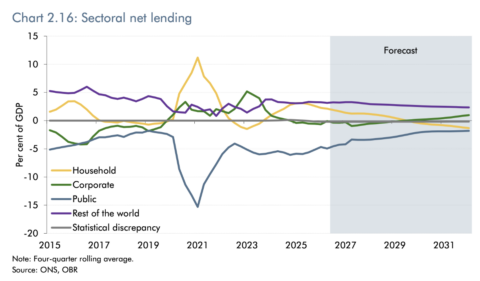
If you only take one thing from the 2026 budget, it should be from the Sectoral Net Lending data on page 53 of the OBR’s October 2026 Economic & Fiscal Outlook (see above chart).
Sectoral balances show who wins and who loses in the economy (see our work on Sectoral Balances here).
In simple terms, the UK’s economy consists of three parts: the government sector, the non-government sector (households and businesses), and the overseas sector. Sectoral balances simply record the sum of transactions between the three sectors because one sector’s spending is another sector’s income. Put another way, for one sector to be in surplus, another must be in deficit. And vice versa.
Because the UK government issues currency, it creates new money to spend into the non-government sector (businesses and households). New money funds everything central government ‘buys’: teachers’ wages, pensions, road building and so on. When the government runs a deficit (spends more than it taxes), that government deficit is the non-government sector’s surplus. If the government runs deficits year on year, the sum of those deficits is the ‘national debt’. And by accounting definition, that government debt is the non-government sector’s wealth.
Remember, the non-government sector has no money of its own. The only way the non-government sector can accumulate financial wealth over time is by successive governments running a deficit. Which means that when a government wants to run a surplus (to pay down its debt), it can do so ONLY by spending less than it taxes. And the ONLY source of surplus for the government of an economic system that runs a permanent deficit with the overseas sector is the households and businesses that make up the non-government sector.
UK Budget 2026: Does this sound like a resilient economy to you?
The OBR’s sectoral net lending forecast shows that the UK government intends to run a surplus. It also expects businesses to run a surplus. This means households must be in deficit – spending more than they earn.
This budget will withdraw financial wealth from the non-government sector, likely reduce investment, and make ordinary families poorer and less resilient. Indeed, the Chancellor barely mentions resilience in his speech, and when he does, he means short-term economic performance holding up against forecasts. The speech never describes ‘resilience’ in a systemic or ecological sense: not for energy, supply chains, communities or climate.
Ignoring resilience makes the UK poorer. And the OBR proves it
Everything in the OBR’s October 2026 Economic & Fiscal Outlook hinges on energy prices and the adverse impact on the UK’s economy caused by the conflict in the Middle East. A war in which the UK has almost no involvement and little influence. The OBR paints a bleak picture even with its (arguably ridiculous) assumption that energy prices will fall. This creates huge downside risk. Whatever happens, ordinary folk will bear the brunt, and the government seems content to let them.
Rising energy prices feed inflation. And rather than address the root cause of inflation, the UK’s default institutional response is for the Bank of England to raise interest rates. As the excellent Vince Gomez explains in his Sovereign Money Blog, an energy shock is a question of resources. Raising interest rates does nothing to increase the supply of energy, increases costs for ordinary people and increases the cost of investing in replacements. The impact on households is clear.
Rising interest rates (s.1.8) will make your bills more expensive:
‘Our central economy forecast is conditioned on Bank Rate reaching just over 4¼ per cent by mid-2027 and just over 4½ per cent by the end of the forecast period’.
Earnings growth (s.1.11) remains stagnant:
‘In the central forecast, limited second-round effects of externally driven inflation on nominal wages – and labour market looseness – means we expect no real earnings growth in 2027. Real wage growth then recovers to around ½ a per cent a year by 2030’.
Businesses will rebuild their profits on the back of working people by capturing a greater share of labour productivity:
‘That medium-term growth rate is slightly below growth in output per worker as we expect firms to rebuild profit margins and the rate of return on capital to recover’.
Real household disposal income deteriorates and only recovers if the energy price shock subsides:
‘We expect RHDI per person – an indicator of living standards – to fall slightly in the near term (Chart 1.5). RHDI per person then partially recovers as the energy price shock subsides. But, in 2030-31, it is only around 2 per cent above pre-pandemic levels’
What a time to be alive! And then it gets worse
The OBR openly admits that it is government policy to maintain a stock of unemployed people to balance the books (s.1.27):
‘if unemployment returned to its estimated equilibrium rate two years earlier than the central forecast, borrowing could be £16 billion a year lower on average, or if it instead peaked at around 7 per cent, borrowing could be an average of £20 billion a year higher than our central forecast.’
Every person without a wage to house, feed, and clothe themselves and their family is a government policy failure. Assuming an equilibrium rate of unemployment means joblessness and all its social consequences are a state-sponsored feature, not a bug, of our economic system. For all the fine words about cutting welfare, individual responsibility and pathways to work, ministers simply do not understand that unemployment is a political choice of their own making.
s.2.27 reveals who this policy really serves. State-sponsored unemployment weakens workers’ bargaining power as the basis of higher margins for employers:
‘a significantly looser labour market restricts workers’ capacity to bargain for higher wages’
At s.2.8 the OBR’s own data shows that just 0.4 vacancies exist for every unemployed person. Put another way, that’s 2.4 unemployed people per vacancy. Cutting welfare does not create any more jobs. It just makes already poor people poorer still and less able to recover from the consequences of unemployment. The Chancellor has no macroeconomic solution to eliminate unemployment in his budget. And if the government is serious about following through with welfare cuts, it will compound a poverty crisis of its own making.
Those still in work will be feeling the pinch
Households’ savings are expected to collapse with the savings rate (s.2.53) plummeting from 5.5% to just 0.5% in 2031:
‘In the face of this, we expect consumers to gradually reduce saving to smooth their consumption over time.’
This is no surprise. The sectoral balances prove that the only source of the government, business and overseas sectors’ surpluses is household savings. And households’ consumption continues to stagnate due to weak real income growth (s.2.54):
‘This leaves real consumption as a share of GDP at 61 per cent at the end of the forecast, over 2 percentage points below the average level from 2010-2019’
That’s nearly two decades since the global financial crash, and household consumption has failed to recover.
An unforgivable budget. With an unforgivable omission
The UK is desperate for a macro response to the polycrisis of climate breakdown and biodiversity collapse, collapsing living standards, energy and food price shocks and structural unemployment. And yet the Chancellor has barely even tweaked at the edges. A currency-issuing government faces no purely financial constraints. If he wants to employ an army of workers to build houses, to decarbonise our energy system, to grow food, to retrofit homes for warmth and cooling, to restore nature, to provide social care or do any of the myriad things that need to be done, the Chancellor is constrained only by the government’s ambition and the short-term availability of real resources.
And do you know how often the Chancellor’s speech mentions resources? Not once.
A Chancellor who does not understand that it is his job to create money to fund investment in real resources to create economic, ecological and societal resilience does not have a grip on his brief.
Healey opened his speech by claiming it was a budget for the working people of Britain. And yet the most frequently mentioned words in his speech are business and defence. The Chancellor’s priorities are clear. And they’re not working people and families, nor the climate. And for a Labour Chancellor, that is indefensible.
