Scotland's sectoral balances
Sectoral balances operate according to one fundamental principle: all financial transactions across the economy must balance. In other words, one sector or person’s deficit is another sector or person’s surplus. The latest sectoral balances for Scotland provide key economic takeaways for each of the three sectors in Scotland’s economy.
This analysis sheds light on Scotland’s wider finances. It goes beyond the work of the Scottish Fiscal Commission, which concentrates solely on the Scottish Government’s fiscal position. It moves beyond the work of the Scottish Government’s Office of the Chief Economic Adviser. The Scottish Government’s annual publication, Government Revenue and Expenditure Scotland, does not use the tool of Sectoral Balances. As a result, we lack a macroeconomic overview of the Scottish economy within the UK.
Scotland's private Sector
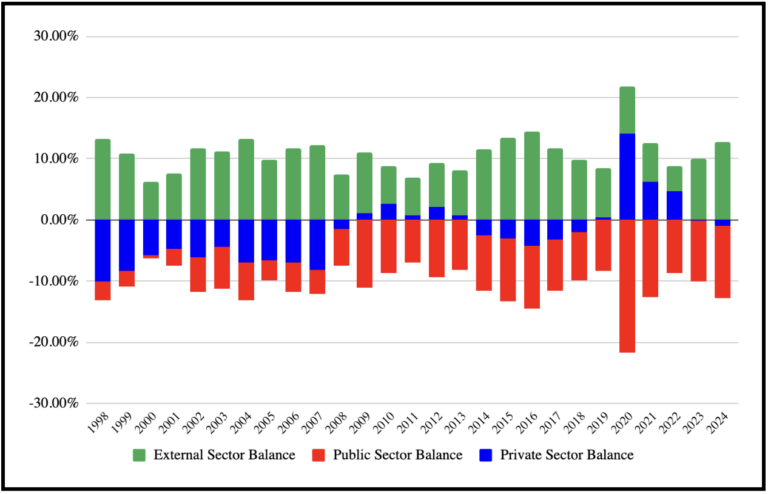
Only nine times since 1998 has Scotland's private sector been able to netsave. Surplus years normally follow crisis (GFC 2009-13) and (COVID 2020-22). Most years Scottish households and businesses spend more than they earn.
Scotland's Public Sector
On average, Scotland's three levels of
government (UK, Edinburgh and local authorities)
run a deficit of around 10% of GDP. This includes
spending in and on behalf of Scotland. The public
sector balance is ‘ex post’, meaning it reacts to
the other two sectors. If we save less and import
less, then the public deficit will fall. If we save more
and import more, then it will rise.
Scotland's Foreign Sector
Since 1998, the external sector has
benefited the most. This is a result of
Scotland’s net import position, whereby foreign nations (including other parts of the UK) sell more goods and services to Scotland than Scotland sells to them. Add net financial flows, and Scotland's foreign sector receives around 10% of Scotland's GDP.
Scotland's Sectoral Balances - Updated for 2024*
Insights for Scotland's economy
Since devolution (1998), Scotland’s economic structure has not changed significantly. Over almost three decades, the foreign sector (including the rest of the UK) has accounted for a net 10% of Scotland’s GDP. Scotland’s private sector (businesses and households) is rarely in surplus in ‘normal’ years. The public sector balance has never been in surplus, and after the GFC (2008), the public sector deficit roughly doubled to around 10% of GDP.
In the simplest terms, the increasing financial wealth that flows to Scotland from the UK government – which is the only domestic institution that can create new net wealth for Scotland – flows out of Scotland. In sum, Scottish households have not seen the net financial benefits of public deficit spending beyond temporary periods of crisis. More detailed insights below:
Community Wealth Building
The Scottish Government has introduced
legislation to support communities in
retaining more financial wealth. Success
would see the private sector move into
surplus. Using Scotland's Sectoral Balance
(SSB) we can see that any increase
must come from either the public sector
(more government spending) or from a
reduction in external financial flows.
A wellbeing economy
The Scottish Government and civic
Scotland are committed to creating
a wellbeing economy. But what does a
wellbeing economy look like? A wellbeing
economy is unlikely to see the private sector
consistently spending more than it earns
while a substantial share of net financial
flows leaves Scotland.
Foreign direct investment
Scotland's Sectoral Balances show the success
of FDI (from the investor perspective) as part of
a large foreign sector surplus: Scotland sends
more financial wealth abroad than it receives.
The benefits for the private and public sectors
are harder to see. GNI figures published in 2023
indicate that the shift from oil and gas towards
services and renewables has not reduced
foreign returns from Scotland.
Public sector reform
SSB helps frame the Scottish Government's
public sector reform. All reductions in
Scottish Government spending must come
from either Scottish households &
businesses or from foreign-owned (including
rUK)businesses. There is a choice to be made.
But first the Scottish Government must
understand financial flows and the impact
of proposed cuts.
Exports
There is a lack of evidence that shifting
away from fossil fuels to renewables has
changed the extractive nature of Scotland's
economy. Renewable energy offers an
opportunity for both Scotland's private
sector and public sector to earn a larger
share of Scotland's financial flows. But this is
not materialising. This puts a just transition
in question.
Poverty, income and wealth
inequality
Few Global North countries have seen their
households and businesses save so rarely as
Scotland. For example, England's private sector
net saves almost twice as often. However, the
aggregate figure also hides deep inequality
within the private sector. As private sector
net saving falls, it primarily hits those
least able to cope. The cost of living crisis is
in many ways a lack of private sector net saving.
Lessons for Scotland's economy
Because modern economies rely on robust sales and production to sustain growth, imbalances in any one sector can lead to broader economic instability. For example, if the public sector spends less (public sector reform, fiscal austerity, etc.), the resulting decline in demand must be offset by either reduced private-sector saving or increased exports to prevent economic contraction.
Understanding these relationships is essential for designing fiscal, monetary, and trade policies that promote full employment, stable prices, wellbeing, and economic resilience. Without the snapshot of sectoral balances, governments can miss the big picture.
Learning lessons without
data is difficult
The Scottish Government does not produce
Sectoral Balances for Scotland despite all of
the information being available. However,
up to date data on Scotland's financial flows
are out of date. This data is collected as part of the
Gross National Income figures. Sectoral Balances
and GNI figures are essential to understand the
impact/success of CWB, public sector reform
and a wellbeing economy.
The current fiscal
settlement does not deliver
for scotland's Households
or businesses
Despite an increase in public spending across
thirty years, Scotland's households rarely net
save. The first economic priority of a government
with currency creating powers (Westminster)
should be to ensure the financial health of its
private sector. The current fiscal settlement fails
Scottish households & businesses.
GERS is incomplete
Every year the Scottish Government
releases Government Expenditure & Revenue
Scotland
(GERS). This shapshot
of Scotland's public finances is
incomplete without GNI or detailed sectoral
balances.
Lessons for an independent Scotland
Should Scotland become independent, the current level of public deficit is likely to continue in the short to medium term. It is unrealistic to expect net exports to rise quickly or significantly to reduce the foreign sector surplus, especially as the trend appears to be the opposite. Likewise, Scotland’s private sector is unlikely to cope with more austerity. Therefore, the current level of public deficit would be essential to support the financial stability of Scotland’s private sector.
In sum, Scotland’s current sectoral balances are a good proxy for the first few years of independence, but to pursue a wellbeing economy, the private sector would need to run a regular surplus. We must assume that the public sector funds a private sector increase in an independent nation. SSBs pose no structural problems in the short term, but the longer Scotland remains without its own currency, the more the pressure builds on public finances.
Scotland's currency
If the Scottish Government were to borrow
sterling to cover the annual deficit,
rather than spending its own currency,
Scotland could face insolvency concerns.
Similary, without its own currency Scotland
would need to continue to rely on FDI
to increase Scotland's money supply.
Reducing Financial
Flows to the foreign sector
A key priority would be for Scotland to decrease
FDI and increase net exports. Although a substantial
foreign sector surplus is not unsustainable, and
in some ways is material beneficial, financial
flows tend to come from the ownership of resources
and it is likely that Scotland would like to increase
the ownership of its resources.
Public spending must
stay in scotland
Money spent by the Scottish Government
must stay in Scotland. This highlights the
need for the Scottish Government to fully
committo CWB and the importance of
collecting GNI data and compiling SSB.
Fiscal rules won't work
An attempt to shrink the public deficit would
shift the burden onto households and
businesses. With stagnating incomes and
rising inequality, Scottish households cannot
sustain higher debt without risking financial
instability. An independent Scotland would face
the same accounting reality. Fiscal rules are not
appropriate for an independent Scotland.
Balance the economy
not the public budget
An independent Scotland should focus on balancing
the economy and not the government budget.
A balanced economy focuses on full employment,
reduces income and wealth inequality, directs
resourcesto the real economy and operates within
planetary boundaries.
structural not
temporary challenges
Independence for Scotland will not
immediately solve Scotland's structural
economic challenges which have been
embedded over (at least) thirty years.
Moving to a Wellbeing Economy will require
a significant shift in economic values,
goals, metrics and performance indicators.
Support our work to encourage the Scottish Government to use of complite Scotland's Sectoral Balances
UPDATE
SCOTTISH PARLIAMENT – WRITTEN ANSWER, 15 September 2026
QUESTION:
Paul McLennan (East Lothian Coast and Lammermuirs) (Scottish National Party): To ask the Scottish Government whether it will commit to collecting Gross National Income, or equivalent net financial flows, data for Scotland, presented within a sectoral balances framework, to evidence the impact of the Community Wealth Building (Scotland) Act 2026 in reducing financial outflows from households and businesses.
ANSWER:
Hannah Mary Goodlad: In implementing provisions in the Community Wealth Building (Scotland) Act 2026, the Scottish Government will consider how relevant and meaningful statistics can contribute to evaluating the Act’s impact. The Scottish Government has previously developed experimental statistics for Gross National Income (GNI) and primary income account statistics, which deal with aspects of income flows into and out of Scotland, including Foreign Direct Investment, and has shown a net outflow of income from Scotland, with the latest being published in 2023.
The Sectoral Balances Framework
The concept of sectoral balances, developed by British economist Wynne Godley (1926-2010), has long been a well-established tool in macroeconomic analysis. Sectoral balances provide a vital framework for understanding the interconnected dynamics of modern economies. The St. Louis Fed (2025) tracks the US sectoral balances. The private bank J.P. Morgan (2024) used sectoral balances to ask, “Is the deficit threat being overhyped?” The European Central Bank (2012) used the approach to analyse imbalances in the euro area.
Three sectors encompass every financial transaction in the economy. As every financial transaction requires a corresponding debit, the sectoral balances must balance. By definition. This allows us to track where someone’s deficit ends up (at a net level) as someone else’s surplus.
Insights from the sectoral balances framework include:
Fiscal rules don't work
Setting a rule for something created ex post and largely exogenous (i.e. the public deficit) is a rather futile target. Surely there are better targets that are easier to hit? When fiscal rules focus on limiting public debt, they overlook the broader perspective.
Putting public deficits in context
Public deficits are normal, and for a net importer (like Scotland), they are essential. Otherwise, the private sector, not the public sector, would bear the costs of imports.
Need to balance an economy
Even without issuing their own currency, governments are better equipped than the private sector to manage rising debt. Private debt—not public—poses the real risk. When private borrowing surges, the likelihood of financial crises increases.
Shows how trade and fiscal spending impacts the economy
Insights from sectoral balances underscore the crucial interplay between government deficits and private sector balances, offering a powerful lens to assess how fiscal policy decisions and trade dynamics affect a nation's economy.
A powerful macroeconomic lens
By examining the financial flows between these sectors, sectoral balances offer a comprehensive view of how economic activity is distributed and sustained at the macroeconomic level.
A tool in the macroeconomic data toolkit
Sectoral balances are not designed to tell us anything about distribution within the private sector, levels of inequality, or the underlying causes of these balances. However, it sets the stage for a more in-depth analysis of the macroeconomy.
- See the data behind Scotland's Sectoral Balances
- See more work from Ciaran McKenna who compiles the SSB
- Download our interactive SSB excel spreadsheets
- Support our work on Scotland's Sectoral Balances
- Receive an alert when our SSB peer reviewed paper is published
- Find out more about the Sectoral Balances framework